
Do you want to know one of the biggest secrets for sounding clearer in American English?
It is not a new vowel. It is rhythm and sentence stress. If the beat is wrong, the sounds can be right and the listener still has to ask you to repeat the line.
Go through this episode. I’ll share tips from a lesson in the Pronunciation Pro training program so you can hear sentence stress and then use it yourself.
What is American English rhythm?
English is a stress-timed language. Important words get more time and a little more pitch. Small words get shorter. That rise and fall is the rhythm. If every word gets the same beat, the sentence sounds flat, even when the vowels are clean.
Intonation is the pitch. Rhythm is the timing. They work together. For the pitch half, see American English intonation (part 1).

Sentence stress: which words get the beat
Sentence stress means you make the content words stand out: nouns, main verbs, adjectives, adverbs. The little words (a, the, to, of, and) stay light.
Try this line two ways:
- Flat: I will send the report on Friday.
- Stressed: I will SEND the REPORT on FRIDAY.
The second one is easier to follow on a call. You are not shouting. You are giving the important words a little more length.
How to practice American English rhythm this week
Pick one sentence you actually say at work. Mark the two or three words that carry the meaning. Say the line once, then again with those words a bit longer. Record it. Listen only for the beat, not for every vowel.
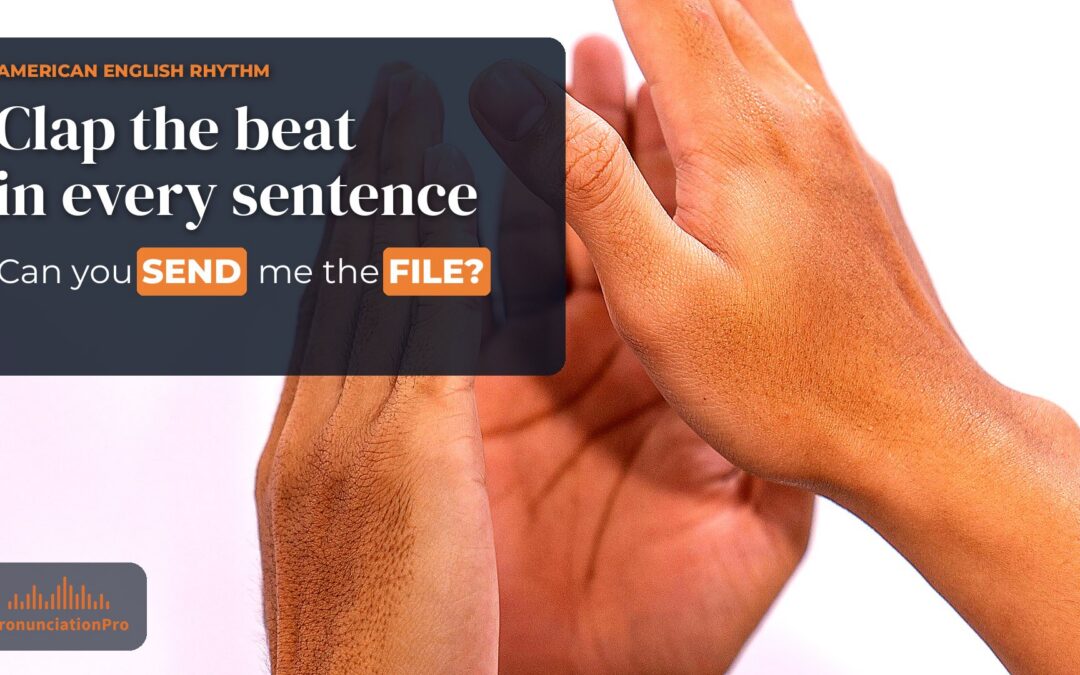
Another quick drill: clap once on each stressed word. “SEND” clap. “REPORT” clap. “FRIDAY” clap. The unstressed words ride between the claps. If you cannot clap without rushing, you are still giving every word the same beat.
Common slip: stressing will or the because you are being careful. Those words can stay small. Save the beat for the word the other person needs.
Two minutes a day is enough. For a daily plan, see daily English pronunciation exercises and 10 helpful tips for mastering English pronunciation.
Do this on a real email line, not a textbook sentence. The beat has to match words you already say, or it will not show up in the meeting.
Why stress-timing matters for clarity
In many languages, every syllable gets about the same time. In American English, the stressed syllables come at a fairly steady beat, and the unstressed syllables squeeze in between them. That is why “I’m going to the store” can sound like “I’m GOnna the STORE.” Listeners use this beat to find the important words. When the beat is missing, they have to work harder to understand you, even if every sound is correct.
A 2-minute rhythm drill
- Pick three short lines you use often, like “Can you SEND me the FILE?”
- Mark the content words and say only those words, with a steady beat.
- Add the small words back in without changing the beat. Let them get short and quick.
- Record and compare. The stressed words should be longer and a little higher.
Rhythm and stress work together. Go deeper with Rhythm Matters: Enhancing Clarity in American English and practice the word-level beat with fixing word stress mistakes.
If you want a coach to hear your sentence stress, start here: https://pronunciationpro.com/trial/.
