
British vs American accents can sound surprisingly different, even though Americans and the British have spoken and written the same English language for centuries. From pronunciation and vocabulary to the way certain sounds are produced, these differences developed over hundreds of years.
The difference didn’t happen all at once. In the 17th and 18th centuries, English speakers in Britain and the American colonies shared many pronunciation features. Over time, however, accents continued to change in both places.
One important change occurred in parts of England, particularly around London and southern England, where many speakers gradually stopped pronouncing the “r” after a vowel in words like car, hard, and water. This non-rhotic pronunciation later became associated with prestigious forms of British English. Many American accents, meanwhile, remained rhotic and continued pronouncing the “r.” Migration and contact with different languages and regional dialects also helped shape the wide variety of accents heard in both countries today.
Why Did British vs American Accents Become Different?
In the 1700s, English speakers in Britain and the American colonies generally pronounced the “r” in words such as car, hard, and water. Over time, however, pronunciation began changing in parts of England—particularly in London and southern England.
One major change was the gradual loss of the “r” sound after vowels. This is known as non-rhotic speech. The pronunciation became increasingly associated with prestigious varieties of British English and eventually influenced what many people now think of as a traditional British accent.
Meanwhile, many English speakers in North America continued pronouncing the “r.” This is called rhotic speech, and it remains a major feature of most American English accents today.
But the difference between British and American English isn’t just about the R sound. Over hundreds of years, geography, migration, cultural contact, and changes within both countries caused vocabulary, vowel sounds, rhythm, and pronunciation patterns to develop differently.
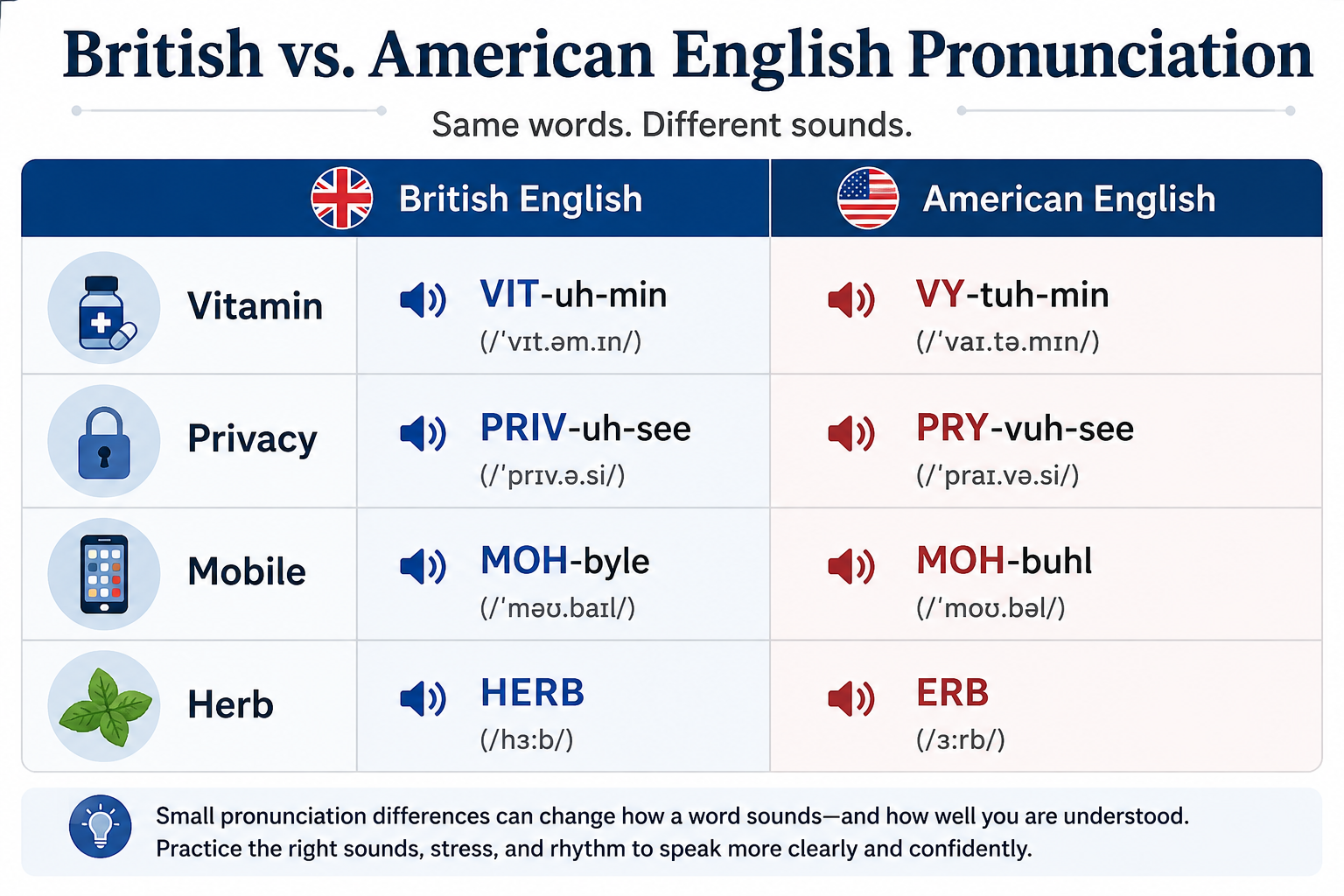
British vs American Pronunciation: Words That Sound Different
Even when British and American English use the exact same word and spelling, the pronunciation can be surprisingly different. Here are a few common examples of British vs American pronunciation:
Vitamin
- British English: VIT-uh-min
- American English: VY-tuh-min
Privacy
- British English: commonly PRIV-uh-see
- American English: commonly PRY-vuh-see
Mobile
- British English: MOH-byle
- American English: MOH-buhl
Herb
- British English: the H is usually pronounced: HERB
- American English: the H is usually silent: ERB
These differences developed gradually as British and American English evolved on opposite sides of the Atlantic. And pronunciation isn’t the only difference—you’ll also find differences in vocabulary, spelling, stress patterns, and even the way certain vowel sounds are produced.
Are All American Accents Rhotic?
Most American English accents are rhotic, meaning speakers pronounce the R in words such as car, hard, and water. But American English includes many regional accents, and not all of them follow the same pattern.
For example, traditional Boston and some New York City accents are known for dropping the R in certain positions. That’s where the famous Boston pronunciation of “park the car” as something closer to “pahk the cah” comes from. Historically, non-rhotic speech has also appeared in parts of the American South and along the East Coast.
This is an important reminder that there isn’t just one “American accent”—or one “British accent.” Both countries contain many regional and social varieties of English. When people compare a “British accent” with an “American accent,” they’re usually comparing broad, recognizable pronunciation patterns rather than every accent spoken in either country.
Want to Improve Your American English Pronunciation?
Understanding the differences between British and American accents is interesting—but if your goal is to speak American English more clearly and confidently, the most effective approach is focused pronunciation practice with feedback.
At Pronunciation Pro, you’ll learn the sounds, stress, rhythm, and intonation patterns of American English through step-by-step training designed by a licensed Speech-Language Pathologist. You’ll also have opportunities to practice what you’re learning and get feedback so you know exactly what to work on next.
Ready to start improving your American English pronunciation? Start your 7-day Pronunciation Pro trial and begin practicing today.
