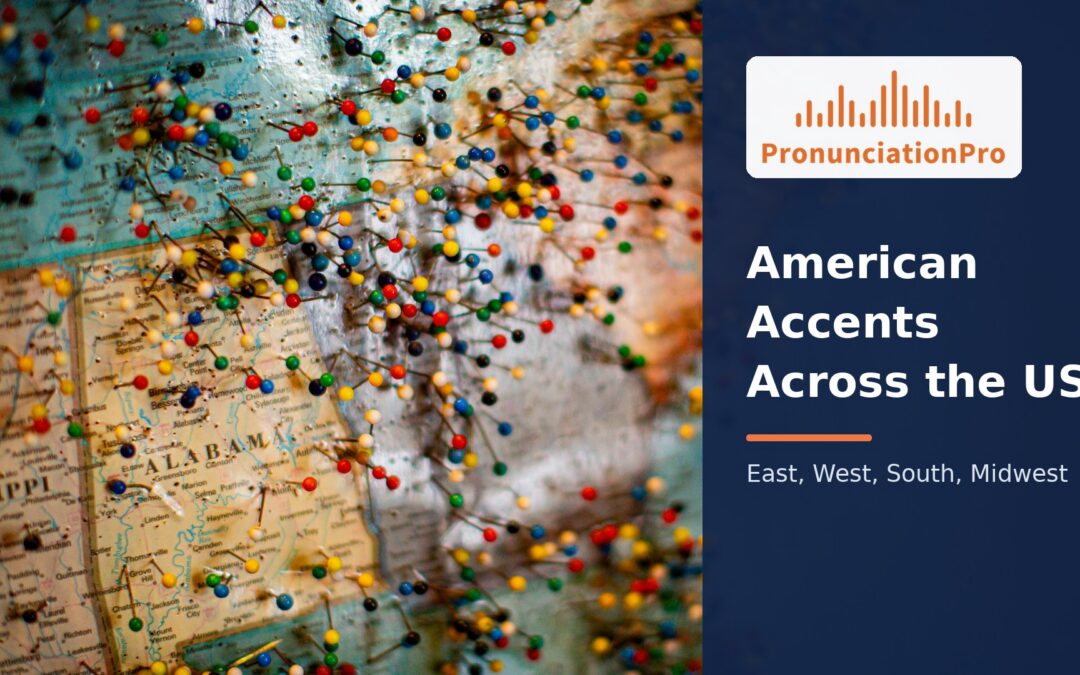
If you searched “east coast accent,” “west coast accent,” or “east coast vs west coast accent,” you are hearing a real split. The East Coast often drops or softens R’s and stretches vowels. The West Coast is closer to the “standard” American sound, with heavier consonants and a lift at the ends of words.
The United States has many regional accents, not one. This guide starts with East Coast vs West Coast, then covers New England, New York City, the South, and the Upper Midwest. For context beyond the US, compare accents across English-speaking countries.
Different American Accents by Region
When people ask about the different American accents, or accents in the US, they usually mean regional sounds. Someone from Boston, Chicago, or Atlanta can say the same word in noticeably different ways. These are real regional accents, not mistakes. An accent is about sounds (vowels, R’s, rhythm). A dialect also includes vocabulary and grammar, like “y’all,” “soda” vs “pop,” or “sneakers” vs “tennis shoes.”
Try a quick self-check. Do you say “y’all” to a group? Do you call every soft drink “coke”? Are they sneakers or tennis shoes? How do you say “mayonnaise”? Your answers say a lot about where you learned your English. Many Americans will even ask, “What accent do I have?” because they don’t think they have one at all.
As you read each region below, say one example sentence out loud and listen for which sounds change. You don’t need to copy any of these accents. Hearing them clearly makes American speakers easier to understand.
East Coast vs West Coast Accent
East Coast (Boston, New York, and much of the Northeast) is the one people usually mean by “east coast accent.” R’s can sound like H’s (cah for car). A’s get longer. Consonants can feel sharper in New York.
West Coast (California, Oregon, and nearby) is closer to general American English. Consonants are a bit heavier, and the voice often rises at the end of a word or phrase. Think Californiaaah more than cawwfee. To compare this sound with another major variety, see British vs American accents.
So east coast vs west coast accent is not “correct vs incorrect.” It is R’s and vowels (East) versus a flatter, more “broadcast” American sound (West).
Eastern New England
“Ah yah pahking thah cah?” is how someone from Boston and Eastern New England might ask, “Are you parking the car?”
People in this region often pronounce R sounds as H’s and stretch their A sounds. You’ll hear it in eastern Maine, Vermont, Massachusetts, New Hampshire, and Rhode Island.
Two more New England habits to listen for. Many speakers add an R to words that end in a vowel, so the name Linda can sound like “Linder.” And you’ll hear “wicked” used for “very,” as in “That was a wicked good game.” The classic test phrase is “Park the car in Harvard Yard,” which often comes out as “Pahk the cah in Hahvahd Yahd.”
Farther west in New England, R’s come back and vowels get tighter. Western New England is less marked, though T’s can fade.
New York City
“I’m tawwkin’ and drinkin’ a cup of cawwfee on the train to Lawng Island.”
That’s “I’m talking and drinking a cup of coffee on the train to Long Island.” New York speech often keeps a strong R in some words, stretches A and O, and hits consonants harder.
The South
“Aah’ve got a flat taar. Aah reckon we kin be there by aate.”
That’s “I’ve got a flat tire. I reckon we can be there by eight.” Southern accents are not one sound (West Virginia, Texas, and Louisiana are not the same). The shared traits are a slower pace, a drawl, shorter vowels in some words, and a dropped G on -ing verbs.
Two more Southern features to listen for: “I” often becomes a long “aah” (“Aah like you” for “I like you”), and “y’all” is the everyday word for addressing a group. You can hear the Southern drawl in many places south of Washington, DC.
The Upper Midwest
North and west of Chicago, toward Minnesota and Canada, vowels get longer and O’s get rounder. “Doncha know where Minnesew-da is?” is “Don’t you know where Minnesota is?” The sound is often wide and flat.
The Midwest
The broader Midwestern accent grew from a mix of settlers from the North and South who moved along the Mississippi River, plus Scandinavian and German immigrants. A few patterns stand out. Some one-syllable words stretch into almost two syllables, so “room” can sound like “ro-uum.” In northern parts of the region, “about” can sound closer to “aboot.”
West Coast
California and Oregon sit close to general American English, with slightly heavier consonants and a pitch rise at the ends of words. “Yeahhh! I’m from Californiaaah.”
Every regional accent has its own music. To hear what they share, learn the rhythm of American English. Then train your own ear and mouth by reading a book aloud for a few minutes a day.
Getting to Know American Accents
Slang and regional accents can make American English feel harder to follow, especially if you are new to the country. The fix is exposure plus focus. Listen to speakers from a few regions, notice the one or two sounds that change most (usually R’s and vowels), and keep your own speech clear and consistent.
If you want to sound clearer in American English, start by hearing the East Coast vs West Coast difference, then pick the regional features you actually need. Understanding the benefits of learning American English can help you choose a focused goal. A short coaching loop helps more than mimicking one movie accent. Start a trial here: https://pronunciationpro.com/trial/.
