
E pronunciation in English can be confusing because the letter E does not always represent the same sound. In words like elephant, each, economy, and early, the letter E is pronounced differently—even though each word begins with the same letter.
So, how do you know which E sound to use? English spelling doesn’t give us one simple rule, but there are pronunciation patterns that can make these words much easier to understand and pronounce. In this guide, we’ll look at the most common E sounds, examples of each, and how to pronounce E at the beginning of English words.
How Is E Pronounced in English?
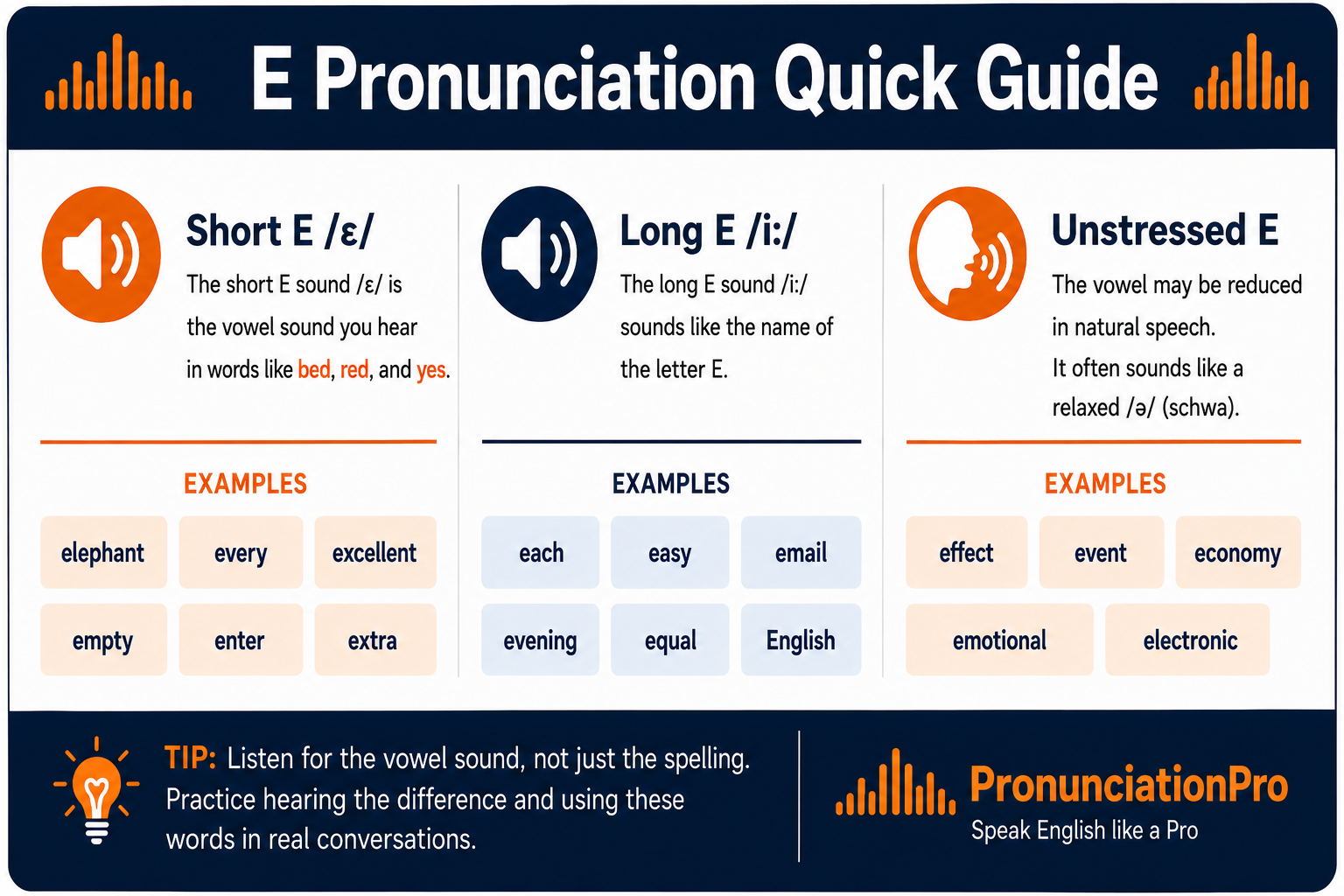
The letter E can represent several vowel sounds in English. The pronunciation depends on the word, the letters around the E, which syllable is stressed, and sometimes the speaker’s accent.
For English learners, three especially useful pronunciations to recognize are:
1. Short E /ɛ/
The short E sound /ɛ/ is the vowel sound you hear in words like bed, red, and yes. At the beginning of words, you can hear it in examples such as:
- elephant
- every
- excellent
- empty
- enter
- extra
2. Long E /iː/
The long E sound /iː/ sounds like the name of the letter E. You’ll hear this sound in words such as:
- each
- easy
- evening
- equal
- English
3. E in an Unstressed Syllable
E can also occur in an unstressed syllable, where the vowel may become reduced. In natural American English, unstressed vowels are often pronounced with a relaxed, neutral vowel sound such as the schwa /ə/.
Examples include words such as:
- effect
- event
- economy
- emotional
- electronic
We’ll get more specific about these patterns below.
How to Pronounce E at the Beginning of English Words
When a word begins with E, you can’t always determine the pronunciation just by looking at the first letter. However, recognizing a few common patterns can help.
Words beginning with E often start with the short E /ɛ/ sound, as in elephant, enter, extra, and excellent. Others begin with the long E /iː/ sound, as in each, easy, and evening. In some words, especially when the first syllable is unstressed, the vowel may be reduced in natural speech.
Instead of trying to memorize one rule for every E word, practice hearing the difference between these vowel sounds and learn new words together with their pronunciation.
Is There a Rule for E Pronunciation in English?
Unfortunately, there isn’t one pronunciation rule that tells you exactly how to pronounce E in every English word. English spelling reflects centuries of changes and influences from other languages, so the same letter can represent different vowel sounds.
There are patterns that can help. For example, ea often represents the long E /iː/ sound in words like each and easy, while E in words like elephant and extra commonly represents the short E /ɛ/ sound. However, English has enough exceptions that these patterns are better used as guides rather than absolute rules.
Stress is also important. When E occurs in an unstressed syllable, its pronunciation may become reduced in natural speech. This is one reason the E at the beginning of economy doesn’t necessarily sound the same as the E in elephant.
For English learners, the best approach is to learn the pronunciation of a new word along with its spelling and practice listening for vowel sounds rather than relying on spelling alone.
How to Practice the E Sound in English
To improve your E pronunciation, practice words in groups based on the vowel sound rather than simply grouping them by spelling.
Try saying these groups slowly:
Short E /ɛ/: elephant, enter, excellent, extra
Long E /iː/: each, easy, evening, equal
Listen carefully to the vowel, then repeat each word several times. Once the individual words feel comfortable, use them in short sentences. Practicing the sound in connected speech helps you carry correct pronunciation into everyday conversations.
If you’re unsure which vowel sound a word uses, check a reliable dictionary with audio pronunciation rather than guessing from the spelling.
Want to Improve Your American English Pronunciation?
Learning English vowel sounds is much easier when you can hear the differences, practice them in real speech, and get feedback on what you’re doing.
Pronunciation Pro helps non-native English-speaking professionals improve their American English pronunciation through step-by-step training, speaking practice, and expert feedback from a licensed Speech-Language Pathologist.
If you want to keep practicing, explore these English pronunciation exercises to improve your sounds, stress, and speaking clarity.
Ready to practice? Start your 7-day Pronunciation Pro trial and begin improving your clarity and confidence today.

I wholeheartedly disagree with the /u/ pronounciation for the vowel “e”.
All of the words listed above, begin with a long eee sound when pronouncing them correctly. I’m just about 50 years old. I’ve only heard these other versions of e words within the last 2 to 3 years.
I’ve asked several people of different ages ..50 years and above raised and educated in different states. We all agree that “/u/” is the lazy tongue way of pronouncing the vowel “e” in English.
In reference to the comment above…language is not static, it’s constantly evolving. Granted you’re allowed to have a preference; however, I infer from your comment that you’re simply resistant to the inevitable development of language.